Mahanarayana-Öl (mit Rezeptur mit heimischen Mitteln)
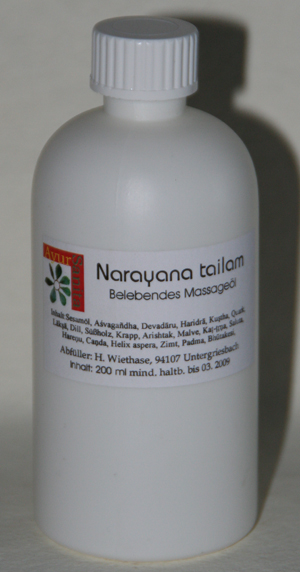
Das Mahanarayana Tailam ist eines der meisterarbeiteten klassischen Kräuteröle der ayurvedischen Medizin (beschrieben u. a. im Bhaishajya Ratnavali). Seine Herstellung folgt dem traditionellen Snehapaka-Verfahren, bei dem wässrige Pflanzenauszüge, Paste (Kalka) und eine Fettbasis über längere Zeit eingekocht werden, bis das Wasser vollständig verdampft ist.
Die Zusammensetzung gliedert sich in folgende Hauptbestandteile:
1. Basis (Sneha Dravya)
- Tila Taila (Sesamöl): Bildet das Trägeröl und sorgt durch seine penetrierenden Eigenschaften (Sookshma) für das tiefe Eindringen der Wirkstoffe in das Gewebe.
2. Flüssige Medien für den Abkochungssud (Drava Dravya / Kwatha) Hauptbestandteil des Suds ist Shatavari (Asparagus racemosus), kombiniert mit weiteren nährenden und Vata-reduzierenden Drogen sowie Kuhmilch (Godugdha):
- Dashamula (die Wurzeln der zehn ayurvedischen Pflanzen)
- Bilva (Aegle marmelos)
- Agnimantha (Premna serratifolia)
- Shyonaka (Oroxylum indicum)
- Patala (Stereospermum suaveolens)
- Gambhari (Gmelina arborea)
- Shalaparni (Desmodium gangeticum)
- Prishniparni (Uraria picta)
- Brihati (Solanum indicum)
- Kantakari (Solanum surattense)
- Gokshura (Tribulus terrestris)
- Bala (Sida cordifolia)
- Ashwagandha (Withania somnifera)
3. Kräuterpaste (Kalka Dravya) Für die Paste werden zahlreiche feingemahlene Kräuter und Harze hinzugefügt, darunter:
- Rasna (Pluchea lanceolata)
- Devadaru (Cedrus deodara)
- Jatamansi (Nardostachys jatamansi)
- Tagara (Valeriana wallichii)
- Chandana (Santalum album / Sandelholz)
- Punarnava (Boerhavia diffusa)
- Pippali (Piper longum) und Maricha (Piper nigrum)
- Ela (Elettaria cardamomum / Kardamom)
- Vacha (Acorus calamus)
- Kushtha (Saussurea lappa)
- Saindhava Lavana (Ayurvedisches Steinsalz)
- Campher (Karpura) als aromatischer Zusatz am Ende des Kochprozesses
Durch das Zusammenwirken dieser reichhaltigen Pflanzenauszüge und Öle entsteht ein hochviskoses, wärmendes Öl, das vor allem zur Regulierung von Vata-Dosha im Bewegungsapparat eingesetzt wird.
Die heimische Entsprechung: Elixier der Knochen-Essenz (Beinwell-Zinnkraut-Dekokt)
Rezeptur
30 g Beinwellwurzel (getrocknet und zerkleinert)
30 g Ackerschachtelhalm (Zinnkraut)
20 g Hagebuttenschalen (ohne Kerne)
1 Liter Quellwasser
Inhaltsstoffe: Allantoin aus der Beinwellwurzel stimuliert die Osteoblastenbildung und die Regeneration des Knochengewebes. Die wasserlösliche Kieselsäure des Schachtelhalms ist ein essenzieller Baustein für das Kollagengerüst der Knochen und Sehnen. Vitamin C aus der Hagebeute wirkt als Co-Faktor bei der Vernetzung der Bindegewebsfasern.
Quelle „Beinwell / wie sein Name saget / heilet die zerbrochenen Beine und stärket das Mark in den Knochen.“ (Bock, H.: Kreütterbuch, Straßburg, 1539). Zum Zinnkraut: „Schachtelhalm macht die Sehnen fest und gewaltig / und hält die Glieder zusammen.“ (Paracelsus: Sämtliche Werke, ca. 1530).
Sammelzeit Beinwellwurzel im Spätherbst; Schachtelhalm von Mai bis Juli; Hagebutten nach dem ersten Frost.
Wirkung Dieses Dekokt remineralisiert das Skelettsystem und festigt die Bänder. Es wirkt der Brüchigkeit der Knochen entgegen und erhält die strukturelle Belastbarkeit des gesamten Bewegungsapparates.
Gegenanzeigen Beinwellwurzel enthält Pyrrolizidinalkaloide; die innerliche Anwendung sollte daher als Kur auf maximal 4 bis 6 Wochen pro Jahr begrenzt werden.
Anwendung Über 28 Tage (einen Mondzyklus) täglich eine Tasse des Absuds schluckweise trinken.
Narayana Tailam (also known as Maha Narayana Tailam) is one of the best-known and most versatile oils in Ayurvedic medicine (Bhaishajya Ratnavali). It is considered the ultimate tonic for calming the Vata dosha and is renowned for its powerful pain-relieving and structure-preserving properties in degenerative conditions.
Key Properties
Therapeutic Profile: Deeply warming, analgesic, antispasmodic, tissue-strengthening, and nervine-soothing.
Tissue Affinity: Specifically targets and rejuvenates muscles (Mamsa), tendons, ligaments, joints (Asthi), and the nervous system (Majja).
Primary Indications:
Chronic joint and back pain, osteoarthritis, intervertebral disc disorders, sciatica, and spondylosis.
Muscular rigidity, stiffness, tendonitis, and paralytic conditions.
Rehabilitation during systemic nervous exhaustion, age-related debility, and Vata-induced insomnia.
Key Ingredients & Composition
Narayana Tailam is prepared by slow-cooking over 30 restorative botanicals within a rich base of sesame oil (Tila Taila) and cow’s milk (Ksheera):
Ashwagandha (Withania somnifera – Winter Cherry): Acts as a potent rejuvenative (Rasayana), strengthening muscle tone and nourishing nervous tissue.
Shatavari (Asparagus racemosus): Provides deep tissue hydration, alleviates inflammatory heat, and restores suppleness to rigid structures.
Bala (Sida cordifolia – Country Mallow): Imparts physical strength and elasticity to muscles, ligaments, and nerves (Balya).
Dashamula (Ten Sacred Roots): Provides deep thermal penetration to relieve pain, spasms, and chronic swelling in the musculoskeletal framework.
Rasna (Pluchea lanceolata): A premier Ayurvedic botanical specifically indicated for joint pain and rheumatic stiffness.
Camphor (Karpura), Eucalyptus & Cinnamon: Added as aromatic synergists to enhance transdermal absorption and stimulate local microcirculation.
The Native European Equivalent: Elixir of Bone Essence
Recipe:
- 30 g comfrey root (Symphytum officinale, dried and chopped)
- 30 g field horsetail (Equisetum arvense)
- 20 g rosehip shells (seeded)
- 1 litre spring water
Active Ingredients & Mode of Action:
Allantoin from comfrey root stimulates osteoblast activity and cell regeneration in connective tissue. The water-soluble silicic acid (silicon) from horsetail provides an essential building block for the collagen matrix of bones, cartilage, and tendons. Vitamin C from rosehips acts as a vital co-factor in collagen synthesis and the cross-linking of connective tissue fibres.
Sources:
“Comfrey / as its name suggesteth / healeth broken bones and strengtheneth the marrow within.” (Bock, 1539).
“Horsetail maketh the tendons firm and mighty / and holdeth the limbs together.” (Paracelsus, c. 1530).
Harvesting Period:
Comfrey root in late autumn or early spring; field horsetail from May to July; rosehips in autumn after the first frost.
Efficacy:
This decoction remineralises the skeletal framework and strengthens the ligaments. It counteracts structural brittleness and maintains the mechanical resilience of the entire musculoskeletal system.
Contraindications & Safety Warnings:
Comfrey root contains pyrrolizidine alkaloids (PAs). Due to potential hepatotoxicity with systemic exposure, internal consumption must be strictly limited to short-term cure treatments (maximum 4 to 6 weeks per year) or applied externally as a compress. Do not use during pregnancy, lactation, or in cases of pre-existing liver conditions.
Application & Preparation:
Simmer the herbs gently in the spring water for 15 to 20 minutes to extract the soluble silica, then strain thoroughly.
As a compress: Soak a clean cotton cloth in the warm decoction and apply directly to painful joints, tendons, or healing bone fractures for 30 minutes.
As a cure: Drink one small cup daily in slow sips for up to 28 days (one lunar cycle).